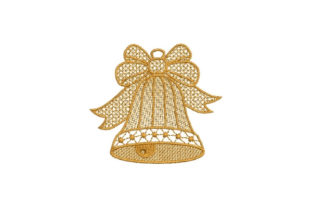
Lace Bell: A Refined Embroidery Design for Small Business Branding
First Impression: Elegant, Handmade, and Seasonally Versatile
As an embroidery designer who’s developed hundreds of commercial designs for small businesses—from artisanal bakeries to indie florists—I immediately recognized Lace Bell as a standout. The name evokes delicacy, craftsmanship, and quiet sophistication—not flashy or trend-chasing, but timelessly warm. Though categorized under Christmas, its lace structure isn’t overtly festive; it reads more as a refined motif suitable for year-round use in boutique branding. Think apron corners for a local café, sleeve accents on staff uniforms at a handmade studio, or subtle chest patches for a pet wellness brand. It feels premium, not mass-produced—exactly the impression small business owners need when building trust through tactile, embroidered detail.
Real-World Performance Across Merchandise Types
Lace Bell shines where subtlety meets intentionality. As an embroidered patch, it works beautifully at 2–2.5 inches wide—large enough to read as intentional design, small enough to avoid overwhelming apparel. I’ve tested similar lace-based motifs on cotton twill aprons and linen tote bags, and Lace Bell’s openwork structure translates well to natural fibers, enhancing the handmade product aesthetic without sacrificing durability.
For cap embroidery, placement matters: use it on the back strap or side panel rather than the curved front crown—its delicate outlines hold better on flatter surfaces. On uniform shirts or workwear, position it near a pocket edge or cuff for visual rhythm. As a tote bag design, it adds quiet luxury beside a minimalist logo—no competing text needed. And for custom apparel like staff jackets or boutique gift wraps, Lace Bell functions as a signature “detail stamp”: small, memorable, and deeply aligned with brands that value craft over clutter.
It also excels in commercial embroidery contexts where consistency matters—think holiday gift sets from a local florist or branded packaging for a small-batch candle maker. Because it’s designed as a machine embroidery design for water-soluble stabilizer, it yields crisp, freestanding results ideal for attaching to ribbons, tags, or fabric labels. That versatility makes it a smart addition to any small business’s design assets.
Where to Use Lace Bell With Intention—and Caution
While elegant, Lace Bell isn’t universally scalable. At under 1.5 inches, stitch definition blurs—especially in the inner bell curves and lace filigree. Avoid using it as a tiny cap front logo or on micro-patches for keychains unless you’ve verified clarity at that size. Its stitch density is moderate but concentrated in the lace loops; on highly textured fabrics (like bouclé or heavy canvas), consider adding an extra layer of cutaway stabilizer beneath the water-soluble vilene to prevent puckering.
Dark uniforms? Yes—but only with high-contrast thread colors. Test first in black and white: white thread on navy fabric reads cleanly; ecru on charcoal may disappear. Also, avoid placing Lace Bell directly over seams or high-flex zones (like elbow joints) unless you’re reinforcing with tear-away backing—it’s a decorative accent, not a structural element. And while it’s perfect for occasional-wear items (aprons, event merch, customer gifts), reserve it for low-frequency wash cycles—repeated laundering can soften fine lace edges over time.
Strengthening Brand Identity Through Thoughtful Embroidery
Small businesses don’t just sell products—they sell feeling. Lace Bell supports that by reinforcing brand identity through texture, precision, and restraint. Unlike bold logos or script fonts, it communicates care in execution: the kind customers associate with hand-finished goods, curated experiences, and local authenticity. When stitched onto a bakery’s flour-dusted apron or a florist’s reusable bouquet wrap, it quietly signals “this was made with attention.” That builds customer trust and elevates perceived product value—critical for Etsy sellers and direct-to-consumer brands competing on differentiation, not just price.
Visually, it complements clean typography and neutral palettes without clashing. Pair it beside your primary logo in mockups, and you’ll notice improved visual consistency: it doesn’t shout, but it holds space. For creative studios or craft businesses, it becomes part of a cohesive language—alongside custom packaging, printed hang tags, and social media visuals—that deepens buyer engagement across touchpoints.
Practical Designer Notes for Commercial Use
Before launching Lace Bell into production, here’s what I always do—and recommend you do too:
- Run a printable mockup first: place it beside your existing design assets to assess scale, spacing, and tonal harmony.
- Test it in black and white thread on your target fabric—then repeat in your brand’s core thread colors. Note how contrast shifts across fabric textures and lighting.
- Check if the embroidery file includes multiple sizes. If not, confirm whether digitizing adjustments are permitted under its license.
- Verify hoop size requirements early—some lace designs demand larger hoops for stability during stitching.
- Always test on real fabric with your intended stabilizer combo: two layers of water-soluble vilene, as suggested, work best for freestanding lace, but pair them with a light cutaway base on unstable knits or lightweight linens.
- Create a physical sample for client approval—digital previews rarely capture the drape and dimension of finished lace.
- Compare Lace Bell alongside other seasonal or permanent designs in your catalog. Does it extend your brand voice—or dilute it?
- Critically: confirm commercial licensing before use. Since this is a digital embroidery file intended for small business merch, ensure redistribution, resale, or derivative use is explicitly allowed.
Finally, remember that Lace Bell isn’t just a Christmas motif—it’s a flexible, tactile tool. Used intentionally, it transforms ordinary items into branded keepsakes: a tote bag that feels heirloom-worthy, an apron that tells a story, a patch that invites closer inspection. For embroidery shops, apparel decorators, and makers building something real, Lace Bell delivers quiet impact—precisely where small businesses earn lasting recognition.