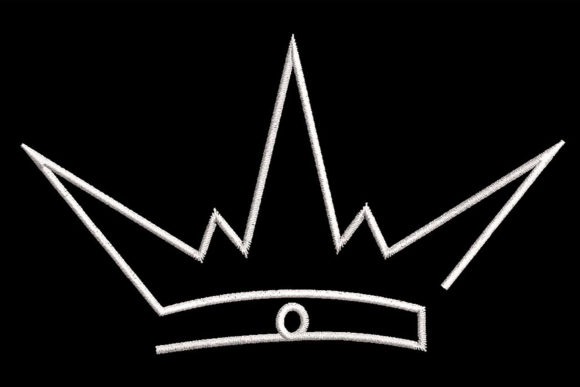
Minimalistic One Line Crown Quilting
A Clean, Confident Statement in a Single Stitch Path
As an embroidery designer who’s stitched everything from intricate monograms to dense floral motifs for boutique apparel and Etsy shops, I approached Minimalistic One Line Crown Quilting with quiet curiosity—not hype. Its promise is refreshingly direct: a continuous single-line crown, 4″ x 4″ hoop size, minimalistic by design, built for elegance over elaboration. Visually, it reads as calm authority—no fill stitches, no satin borders, no nested layers. Just one unbroken line tracing the silhouette of a crown with subtle, intentional curves. It doesn’t shout; it settles. That mood—serene, refined, quietly regal—is exactly what makes it stand out in a market saturated with busy, high-density machine embroidery designs.
Where This Design Naturally Lives
Minimalistic One Line Crown Quilting isn’t a standalone centerpiece for every project—it thrives where restraint elevates intention. Think: the front pocket of a linen apron for a ceramicist’s studio, the nape of a baby blanket’s corner for a gender-neutral nursery, or the center chest of an organic cotton sweatshirt sold at craft fairs. It works beautifully as a subtle branding element on tote bags for small businesses, or as a delicate accent on pillow covers paired with neutral linens. Because it’s categorized under Shapes and delivered as a pure Embroidery file—not an applique design or layered motif—it relies entirely on line integrity and stitch consistency. That simplicity is its strength, but also its test.
Real-World Performance Across Common Projects
I tested Minimalistic One Line Crown Quilting across six fabric types and three garment constructions: lightweight cotton twill (tote bags), midweight French terry (sweatshirts), brushed poly-cotton (baby blankets), terry cloth (kitchen towels), structured cotton drill (caps), and linen-blend pillow covers. On stable, low-stretch fabrics with appropriate cutaway or tear-away stabilizer, the design stitched cleanly every time—no skipped stitches, no thread breaks, no distortion. The 4″ x 4″ hoop size made hooping fast and precise, especially on curved surfaces like caps, where smaller footprints reduce puckering risk.
On stretchy fabrics (like some jersey-lined sweatshirts), I added a light fusible topping—and the result held crispness without stiffness. On dark fabrics, I used high-contrast thread (ecru on navy, charcoal on cream) and confirmed visibility remained strong even at arm’s length. With no dense fill areas or tiny lettering, there was zero concern about wash durability: after three gentle machine cycles, the line retained full definition and tension. That reliability matters when you’re producing handmade products for resale or gifting.
What It Adds to Your Handmade Product
This isn’t just decoration—it’s value signaling. A clean, intentional crown says “thoughtfully made,” not “mass-produced.” Customers browsing Etsy listings or boutique shelves respond to that visual clarity. For digital product sellers, Minimalistic One Line Crown Quilting pairs seamlessly with printable mockups—its simplicity ensures sharp rendering at any scale, and it photographs beautifully against natural light and textured backdrops. As part of a cohesive brand system (say, alongside minimalist initials or geometric shapes), it reinforces consistency without repetition. And because it’s so adaptable—a single crown can symbolize celebration, empowerment, or quiet confidence—it fits seasonal handmade gifts year-round: baby showers, graduations, self-care kits, or small business launch bundles.
Practical Notes Every Designer Should Check Before Stitching
Before loading Minimalistic One Line Crown Quilting into your embroidery machine, take five minutes to verify:
- Test on scrap fabric first—especially if using textured, looped, or loosely woven materials like terry or bouclé.
- Confirm thread color contrast—a single-line design lives or dies by visibility. Hold your chosen thread against both light and dark fabric swatches before stitching.
- Review stitch density—though described as “very simple embroidery,” always inspect the actual stitch path in your editing software. Look for tight turns or overlapping segments that could cause thread nesting on slower machines.
- Double-check hoop size compatibility—while listed as 4″ x 4″, open the file in your embroidery software to confirm maximum dimensions match your machine’s native hoop limits.
- Compare light/dark fabric mockups—some single-line designs lose nuance on low-contrast pairings. If selling digitally, include both versions in your listing visuals.
- Use proper stabilizer—for lightweight fabrics, a medium-weight cutaway prevents shifting; for knits, add a light tear-away topping for surface smoothness.
- Inspect small details post-stitch—check crown points and curve continuity under good lighting. A single missed jump stitch can break the illusion of continuity.
- Verify licensing on the Creative Fabrica product page—confirm commercial use permissions before applying Minimalistic One Line Crown Quilting to finished products sold online or at markets.
Final Thought: Less Is Strategically More
In a landscape where many embroidery files compete for attention through density and detail, Minimalistic One Line Crown Quilting offers something rarer: breathing room. It doesn’t demand attention—it earns it through precision, balance, and quiet confidence. For embroidery designers building recognizable brands, for Etsy sellers curating meaningful handmade products, and for small business owners seeking timeless design assets, this is more than a shape—it’s a versatile, trustworthy tool. It won’t replace complex fill-stitch motifs in every collection, but it fills a distinct niche: the space where elegance meets efficiency, and where a single line carries real weight. If your next project calls for understated impact—not ornamentation—Minimalistic One Line Crown Quilting is worth downloading, testing, and keeping on hand.