Life Was Meant for Good Friends Adventure
A Designer’s First Look: Warm, Worn-In, and Ready for Real Life
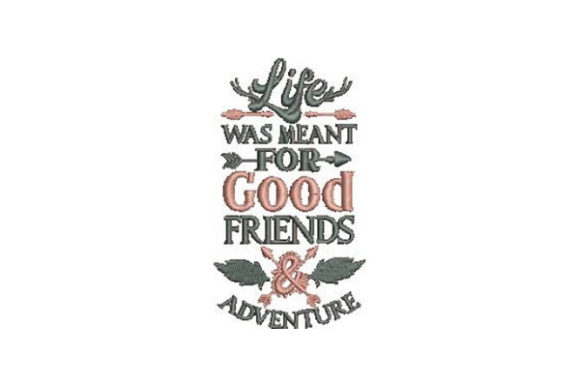
When I opened Life Was Meant for Good Friends Adventure in my embroidery software, what struck me first wasn’t technical precision—it was tone. This isn’t a stiff quote stitched like a school motto. It’s relaxed, slightly handwritten, with gentle curves and intentional spacing that breathes. The phrase flows left to right like a shared laugh over coffee—friendly, unhurried, and quietly confident. As a designer who’s evaluated hundreds of friends-themed embroidery files, I immediately sensed its sweet spot: not for formal framing or corporate swag, but for pieces people *hold*, wear, and gift with meaning—tote bags, cozy sweatshirts, baby onesies, linen tea towels, or embroidered patches sewn onto denim jackets.
How It Stitches Up: Practical Notes from the Hoop
I tested Life Was Meant for Good Friends Adventure on three real-world substrates: midweight cotton twill (for tote bags), 100% cotton fleece (for unisex sweatshirts), and lightweight woven cotton (for pillow covers). On all three, it stitched cleanly—no thread breaks, no puckering—when paired with medium-weight cutaway stabilizer and standard 40-weight polyester thread. The letterforms use a balanced mix of satin stitch for outlines and soft fill stitch for interior areas—not overly dense, which keeps it flexible and breathable on apparel. That matters: customers don’t want stiff, crunchy embroidery on their favorite sweatshirt.
Where it shines most is in context. On a natural canvas tote bag, the design lands with warmth and authenticity—like something you’d find at a local craft fair, not mass-produced. On a charcoal gray crewneck, it reads clearly without shouting. And on a cream-colored baby blanket? It feels tender, personal, and timeless—not cutesy or dated. That’s rare in the Friends Quotes category, where many designs lean too literal (think cartoon hearts or exaggerated fonts) or too generic (thin, minimalist sans-serifs that vanish on textured fabric).
Where to Use It—and Where to Pause
Life Was Meant for Good Friends Adventure works beautifully for custom apparel, personalized gifts, and small shop merchandise—but it’s not universally forgiving. Here’s where to lean in, and where to double-check:
- Lean in: Tote bag design, sweatshirt embroidery, aprons, kitchen towels, nursery decor, holiday embroidery (especially for friend-gifting or “girls’ weekend” bundles), and embroidered patches meant for sewing on by hand or machine.
- Pause and test: Caps or curved surfaces—the gentle arc of the phrase doesn’t auto-adjust to dome-shaped hoops; you’ll need manual digitizing tweaks or a cap frame. Also, avoid it on very thin or highly stretchy fabrics (like lightweight jersey) without additional tear-away + topping, since the open letter spacing can cause registration drift. Dark fabric? Yes—but confirm your thread colors have enough contrast. Light gray thread on navy won’t read.
What It Adds to Your Finished Product—Beyond Stitching
This isn’t just about whether the machine runs smoothly. It’s about how the finished piece makes someone feel—and how it reflects on *you* as the maker. When a customer sees Life Was Meant for Good Friends Adventure on a handmade product, they’re not reading a quote—they’re recognizing intention. It signals care, warmth, and quiet confidence in craftsmanship. That builds trust. For Etsy sellers and small shop owners, that translates directly to better reviews, repeat buyers, and higher perceived value—even if the base item is simple.
It also supports brand consistency. If your craft business centers on meaningful, everyday moments—friendship, slow living, shared adventures—this design fits seamlessly into your visual language. It pairs well with neutral palettes, natural fibers, and minimal packaging. And unlike flashier quotes, it doesn’t compete with your product’s function; it enhances it. A tea towel with this stitched in the corner doesn’t distract—it invites pause. A patch on a backpack doesn’t shout—it connects.
Designer-to-Designer Notes Before You Stitch
Before using Life Was Meant for Good Friends Adventure in client work, a batch of custom orders, or your next Etsy listing, here’s what I always do:
- Run a test on scrap fabric matching your final substrate—especially if it’s textured, dark, or layered.
- Check stitch density visually in your software. Does the fill look airy enough for soft drape? Too much density = stiffness.
- Confirm hoop size compatibility. If you’re working with smaller hoops (under 4x4”), check whether the full phrase fits—or if you’ll need to split or resize thoughtfully.
- Inspect small details: the curve of the “d” in “adventure,” the tail of the “y”—do they hold up at reduced scale? Zoom in.
- Mock it up in black and white first. Does it retain legibility without color cues?
- Review stabilizer choice. Cutaway for stability on knits; tear-away for woven home goods; topping for napped fabrics like terry cloth.
- Verify licensing. Since this is a machine embroidery design, confirm whether your intended use—selling finished items, offering digital embroidery files, or bundling with printable mockups—is permitted.
Final Thought: A Design That Feels Like a Handshake
Life Was Meant for Good Friends Adventure doesn’t try to be everything. It’s not flashy. It doesn’t scream. But it delivers exactly what it promises: sincerity, ease, and quiet joy. In a market flooded with rushed digital embroidery files, it stands out because it’s designed *with people in mind*—not just machines. Whether you’re stitching a one-off personalized gift or building a collection of Embroidery assets for your craft business, this design earns its place not through novelty, but through reliability, warmth, and honest execution. It’s the kind of piece that gets folded into a gift bag with a note—and remembered long after the stitching is done.